Understanding Food Chains and Food Webs
We, as humans, are very fortunate to be on the top of the food chain. This means that we eat and are not eaten. A food chain is a simple diagram that represents the transfer of energy flow. Despite a food chain showing animals eating other animals, and animals eating plants, the arrows do not represent what eats what[i]. No, instead they represent transfer of energy flow. We will first look at food chains as they are easy. Below is a simple food chain:
 The food chain above shows that energy from the grass moves to the sheep and then to the wolf. Simple. Since food chains are so easy we should move onto food webs which are more complex. Though not all that much; they are just a series of interconnected food chains. The one below is an example of a food web. Remember that more than one arrow coming off one organism shows that more than one organism is eating it –they’re in competition.
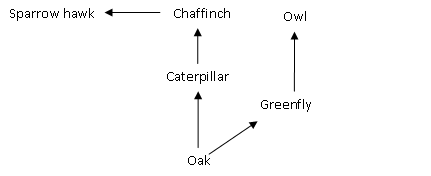 You can split food chains and food webs into different levels, which we shall describe below. They are: 1. Producers 2. Primary consumers 3. Secondary consumers The producers are plants which are right at the very bottom of the food chain and are able to make their own food (see photosynthesis). Thus, they create the energy needed by other organisms in the food chain, and this is where the consumers come in. Primary consumers eat only producers. These are known as herbivores because they only eat plants, and they do not eat other animals. Secondary consumers eat the primary consumers. The ones that only eat primary consumers are known are carnivores, because they only eat other animals. However, some secondary consumers eat both plants and animals, and these are known as omnivores. So, if we look at the original food web, we can now split it up into the different categories you now know. 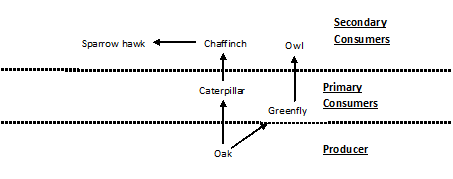 [i] The arrows would have to go in the opposite direction – i.e. grass -> sheep. Just make sure you talk about direction of energy flow. It’s important. |
